Pemuteran: An Off-the-Beaten-Path Escape to Reconnect with Nature
Pemuteran is an off-the-beaten-path destination for those seeking to slow down and reconnect with nature.
My work as a swimming and water safety teacher for children in Bali has taken me to many coastal communities where people live closely with the sea. Among all those places, Pemuteran holds a very special place in my heart.
I first came to Pemuteran when I was setting up a new water safety and swimming class in the Gerokgak district. At that time, Pemuteran village was the only area with available accommodation for me. Since then, I have traveled regularly to Pemuteran every two or three months for work. Those repeated visits gave me the chance not only to work, but also to truly explore, observe, and understand the area beyond a tourist’s perspective.
More Than a Snorkeling Destination
For many travelers, Pemuteran is known as a quiet fishing village famous for snorkeling and diving. But as a local, I see Pemuteran as one of Bali’s most important yet underexplored cultural and natural areas, home to several significant temples and a strong sense of community.
There is so much to see around Pemuteran that it would be impossible to cover everything in one article. In this post, I will focus on Pemuteran village itself, and I will share more about the surrounding areas in future blogs.
A Story of Conservation and Community
Before tourism arrived, around 90% of Pemuteran’s residents were fishermen. The ocean here is rich in marine life, but years ago, unsustainable fishing practices—such as using poison and bombs—severely damaged the coral reefs. As the coral declined, fish stocks also began to disappear, threatening the community’s livelihood.
Everything changed when an Australian diver visited the village and introduced the idea of coral conservation and sustainable fishing to the local fishermen. Together, the community established a marine conservation area and began restoring the damaged reefs.
Today, Pemuteran is famous for its Biorock project, an innovative coral restoration initiative that uses low-voltage electricity to accelerate coral growth. Thanks to this collective effort, the reefs have recovered, attracting divers and snorkelers from around the world—even though Pemuteran is far from Bali’s main tourist hubs.
I learned this story directly from one of the Biorock staff members, which made my snorkeling experience here even more meaningful.
Snorkeling With a Purpose
A local friend who teaches swimming with me introduced me to many special spots around Pemuteran. Naturally, the first thing he took me to was snorkeling right in front of the Biorock office.
Snorkeling here is a unique experience. You can see a wide variety of fish, along with corals growing on underwater iron structures shaped into symbols and words. Each structure carries the name of a donor who helped fund the project.
A few years later, I had the opportunity to contribute to the project myself. We wrote the name of our workplace on one of the structures, and the staff sent us photos when it was first placed underwater. A year later, we received another photo showing coral growing beautifully on it. Knowing that we played a small role in restoring the reef brought an incredible sense of joy and connection.
Beyond the Biorock area, Pemuteran Beach also has natural coral reefs. You just need to swim a bit farther out and head left. However, snorkeling here requires caution—the corals are sharp. I always ask locals where the safest entry and exit points are. Injuring yourself on coral is no joke.
Morning Runs, Temples, and Quiet Sunrises
One of my favorite ways to experience Pemuteran is by exploring the village on foot. I often go for morning runs through the quiet streets while watching the sunrise.
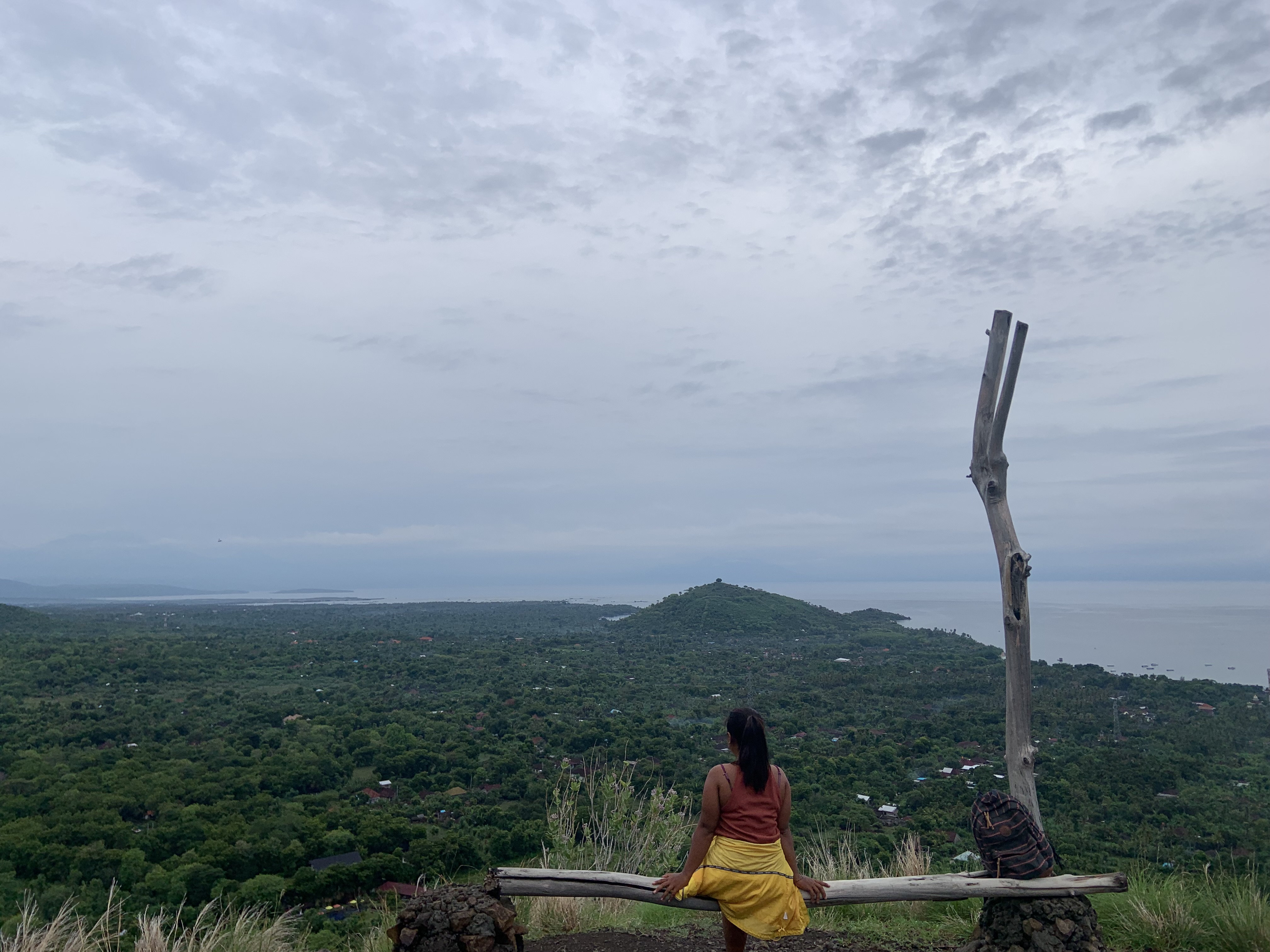
One route takes me about 30 minutes from my guesthouse to Pulaki Temple, where I watch the sunrise from the beach across the temple grounds, accompanied by curious monkeys and a few local residents. Another favorite route is hiking Bukit Kursi. It’s a short and easy hike, and at the top stands Pura Kursi, offering panoramic views of Pemuteran village and its coastline.
Simple Food, Fresh Ingredients, and Local Flavors
Breakfast in Pemuteran is always something I look forward to. At my guesthouse, I often enjoy banana pancakes and fresh fruit. The bananas are naturally sweet, and the fruits—grown locally in the Buleleng region—are incredibly fresh.
This abundance of local produce is one reason I never get bored during my stays here. Along the roadside, farmers and fruit sellers offer grapes, papaya, rambutan, mangosteen, durian, dragon fruit, mangoes, avocados, and more—all at local prices.
For lunch and dinner, I usually visit two locally owned restaurants. The first is Warung Setia in Pemuteran, and the second is Segara Mina, located slightly west of the village.
Warung Setia is more traveler-friendly, offering not only seafood but also a variety of international dishes. My favorites are their sashimi, fresh salads with jeruk Bali, and Thai green or red curry. Every dish is beautifully prepared, and you can feel the care and love put into the cooking by Ibu Setia, the owner and chef.
Segara Mina, on the other hand, is a truly local warung. I was introduced to it by staff from a guesthouse where I once stayed in nearby Sumberkima village. Here, the menu depends entirely on what local fishermen catch that day. Most dishes are cooked in Chinese style, accompanied by Balinese and Indonesian sambal. The food takes time because everything is prepared fresh, so while waiting, we usually play cards and snack on crackers.
Hot Springs and Hidden Corners
Another place I often visit is the Banyuwedang Hot Spring, located about 15–20 minutes from Pemuteran. Nestled in the middle of a mangrove forest, the hot spring feels almost magical, with hot water naturally bubbling from the ground.
The water here is much hotter than the hot springs in Kintamani, and I can usually only stay in for about ten minutes before it feels too intense. Sitting quietly afterward and enjoying the mangrove scenery is my favorite part of the experience.
A Place That Grows on You
As a Balinese, I also take every opportunity to visit the temples around Pemuteran. Combined with the slow pace of life, strong community values, and deep connection to nature, Pemuteran is a place that gently grows on you over time.
It may not offer beach clubs or nightlife, but if you are looking for a meaningful travel experience—one rooted in conservation, culture, and simplicity—Pemuteran is well worth the journey.
written by: Indira Santi
Other Article Gallery